When you’re starting or running a small business, keeping costs under control matters. That’s why the idea of a “free website” can sound very appealing. If there are platforms offering websites at no cost, it’s natural to wonder whether paying for one is really necessary.
The answer depends on what you expect your website to do for your business — and what “free” actually means in practice.
Free website platforms are usually designed to help people get something online quickly. They can be useful for personal projects, hobbies, or very early experiments. For businesses, however, the experience is often more limited than it first appears.
One of the first things many people notice with free websites is branding that isn’t their own. Free plans often include platform logos, adverts, or branded website addresses. Instead of your business appearing fully independent, the website can feel like it belongs to the platform rather than to you. For some customers, this can quietly reduce trust, even if the business itself is legitimate.
Control is another important factor. Free websites usually come with strict limits on design, layout, and functionality. While this keeps things simple, it also means your website may look very similar to many others. As your business grows, those limits can become frustrating, especially when you want to add features, change structure, or present your services more clearly.
Reliability and performance can also be a concern. Free platforms prioritise paid users, which means speed, uptime, and support may not be consistent. If something stops working, help is often limited or slow. For a business website, even small disruptions can result in missed enquiries or lost opportunities.
Another point that’s often overlooked is ownership. With free website platforms, you are building your business presence on someone else’s system. The platform controls the rules, pricing, and features, and these can change over time. What is free today may become restricted tomorrow, or require an upgrade to keep using features you already rely on.
Many business owners also discover that “free” doesn’t stay free for long. As soon as you want a custom domain, remove ads, add basic features, or improve visibility, paid upgrades become necessary. Over time, costs can add up without delivering the flexibility or support that a professionally managed website provides.
That doesn’t mean free websites have no place at all. For very small projects, temporary ideas, or testing concepts, they can be useful. But for businesses that want to appear professional, build trust, and grow steadily, free websites often become a limitation rather than a solution.
A professionally built and managed website offers something different. It gives you full control over your branding, structure, and content. It’s designed around your business rather than around platform restrictions. It also comes with support, maintenance, and reliability, so you’re not left dealing with problems on your own.
In the end, the real question isn’t whether free websites work at all, but whether they work well enough for your business goals. If your website is meant to represent your business, attract enquiries, and support growth, it’s worth investing in something that’s built to do exactly that.
Free websites can get you online. A proper website helps your business move forward.
When Is It Time to Upgrade From a Free Website?
Free websites can be a useful starting point. They allow you to get something online quickly, often with very little commitment. For many businesses, that first step feels like progress — and in the early days, it often is.
However, as a business grows, the needs around its website tend to change. What once felt “good enough” can slowly become a limitation. Knowing when it’s time to move on from a free website can help you avoid missed opportunities and unnecessary frustration.
One of the earliest signs is when your website no longer reflects how seriously you take your business. As you invest more time, effort, and care into what you do, your online presence should grow with you. If your website still shows platform branding, adverts, or a non-professional address, it may no longer match the image you want customers to see.
Another common moment comes when customers start relying on your website more. If people regularly visit your site to understand your services, check details, or decide whether to contact you, reliability becomes important. Free websites often offer limited performance and support, which can quietly affect how your business is perceived. Slow loading pages or occasional issues can reduce confidence, even if customers never mention it directly.
Growth also brings complexity. As your services expand, you may want clearer pages, better structure, or additional features. Free platforms are designed to stay simple, which means flexibility is often restricted. When you find yourself working around limitations rather than improving your website, it’s usually a sign that you’ve outgrown the platform.
Search visibility is another key factor. Many business owners notice that their free website doesn’t bring in enquiries from Google, even after months or years. While free platforms can appear in search results, they are rarely optimised for long-term visibility. A professionally built website gives you a stronger foundation for being found by people who are actively searching for what you offer.
Support also becomes more important over time. With a free website, help is often limited, slow, or entirely self-service. When your website plays a real role in your business, being able to rely on proper support can make a big difference. Knowing that someone is there to help when something needs attention removes a lot of stress.
There’s also a practical tipping point where “free” stops being free. As soon as you want your own domain, remove adverts, improve performance, or unlock basic features, paid upgrades are often required. At that stage, many businesses realise they are paying for a limited solution rather than investing in something built specifically for them.
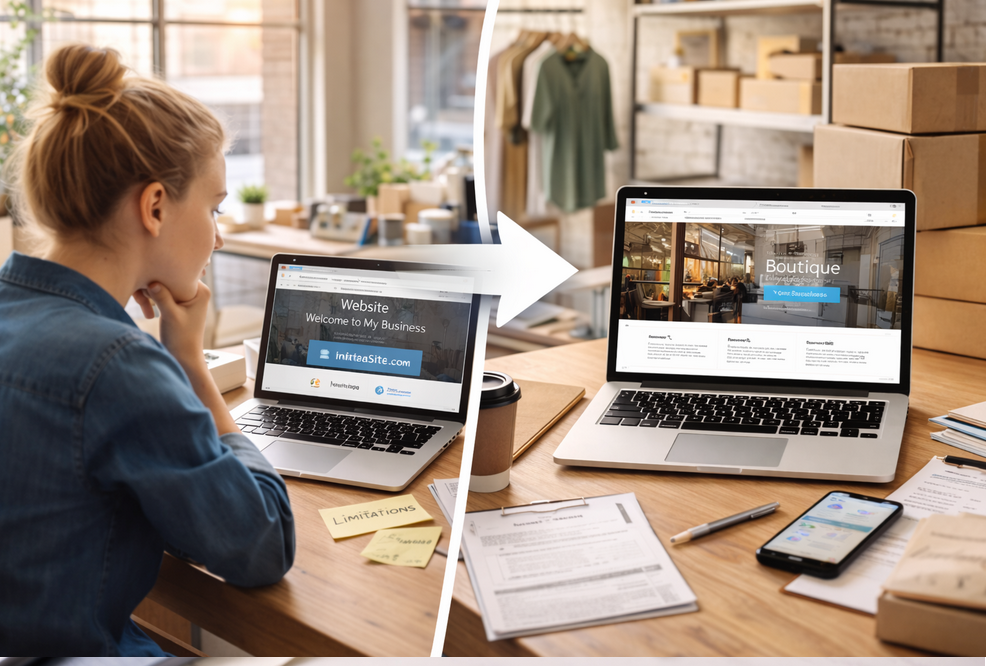
Upgrading doesn’t mean abandoning what you’ve already done. In many cases, content and ideas from a free website can be carried forward into a professionally built one. The difference is that the new website is designed around your business, not around platform restrictions.
The right time to upgrade is usually when your website becomes more than an experiment. When it starts representing your business, attracting real enquiries, and supporting your goals, it deserves the same level of care as the rest of your business.
A free website can help you start. A professionally built and managed website helps you move forward with confidence.